

Qatar Introduces New Excise Tax Mechanism On Sweetened Drinks – Key Compliance Requirements For Businesses
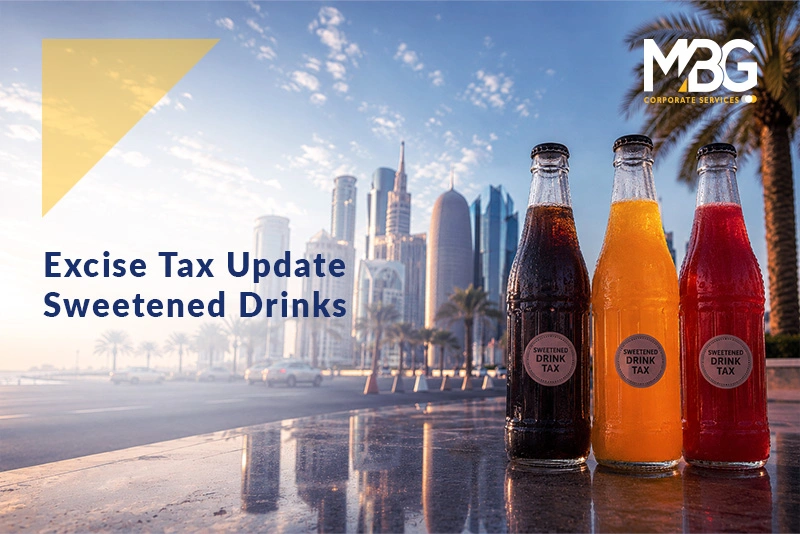
As part of the State of Qatar’s ongoing efforts to strengthen its tax framework and promote public health, the new Excise Tax mechanism on Sweetened Drinks came into effect on 6 July 2026 under Law No. (2) of 2026, amending certain provisions of Law No. (25) of 2018 on Excise Tax. On the same date, the General Tax Authority (GTA) published a comprehensive implementation guide on the Dhareeba platform, setting out the compliance requirements, registration procedures, transitional obligations, and filing deadlines that now apply to affected businesses.
The new mechanism replaces the previous 50% ad valorem Excise Tax regime applicable to Carbonated Drinks, under which Excise Tax was calculated based on the Retail Selling Price (RSP), with a Tiered Volumetric Model under which Excise Tax is calculated per litre according to the applicable sugar tier determined under the GTA methodology. Businesses should promptly assess the impact of the new regime on their product portfolio, registrations, inventory, and compliance processes.
Who This Applies To?
The new regime is relevant for businesses that manufacture, import, distribute, warehouse, or commercially hold Sweetened Drinks in Qatar, including products intended to be converted into drinks such as concentrates, powders, gels, extracts, and similar products. It also applies to commercial stockpilers holding inventory of Sweetened Drinks subject to the transitional provisions, businesses that previously declared Carbonated Drinks under the former 50% ad valorem regime and are required to amend their product registrations, and operators of Excise Tax warehouses.
No Excise Tax Registration Threshold
The GTA has confirmed that there is no registration threshold for Excise Tax under the Tiered Volumetric Model. Any person intending to import, manufacture, or operate a tax warehouse in relation to Sweetened Drinks must register for Excise Tax and comply with the applicable requirements, irrespective of the volume of business.
Key Updates Under The GTA’s Implementation Guide
Tiered Volumetric Model – How Excise Tax Is Now Calculated
Under the new Tiered Volumetric Model, Excise Tax is calculated on a per-litre basis according to the applicable sugar tier determined under the GTA methodology. Products containing less than 5g of total sugar per 100ml are subject to an Excise Tax rate of QAR 0 per litre. Products containing 5g to 7.99g per 100ml are subject to QAR 0.77 per litre, while products containing 8g or more per 100ml are subject to QAR 1.06 per litre. Products containing only added artificial sweeteners and no added sugar fall within the Tiered Volumetric Model but are subject to an Excise Tax rate of QAR 0 per litre.
Expanded Scope Of Excise Goods
The updated schedule includes Sweetened Drinks containing added sugar or other sweeteners and extends to products intended to be converted into drinks containing sugar or added sweeteners, including concentrates, powders, gels, extracts, and similar products. The Excise Tax applies only to packaged products. Beverages prepared for immediate consumption and supplied to final consumers in open, non-sealed containers—such as drinks served in restaurants—as well as beverages prepared by individuals for personal, non-commercial consumption, fall outside the scope of the new model.
Products Outside The Scope Of Excise Tax
The GTA has confirmed that 100% natural fruit and vegetable juices with no added sugar or sweeteners, qualifying milk and dairy products, infant formula, meal replacement products, and drinks intended for special dietary or medical purposes, subject to the prescribed legislative conditions, are excluded from the scope of the Tiered Volumetric Model.
Laboratory Test Report – Mandatory For Product Registration
Businesses must submit a laboratory report issued by a GTA- and Ministry of Public Health (MoPH)-accredited laboratory when registering Sweetened Drinks on the Dhareeba platform. The laboratory report must specify the product’s total sugar content, natural sugar content, added sugar content, and artificial sweetener content per 100ml to determine the applicable Excise Tax tier. Where a qualifying laboratory report is not provided, the product may be classified under the highest Excise Tax tier, attracting a rate of QAR 1.06 per litre, until an acceptable laboratory report demonstrating a lower sugar tier is submitted.
When Does Excise Tax Become Due?
Under the Excise Tax framework, Excise Tax generally becomes due when Sweetened Drinks are released for consumption, including upon importation outside a tax suspension arrangement, local production outside a tax suspension arrangement, release from a tax warehouse, or in other circumstances prescribed under the Excise Tax legislation.
Transitional Declaration Obligations – Deadlines You Cannot Miss
The GTA has introduced transitional provisions for businesses holding Sweetened Drinks as at 5 July 2026. In a subsequent clarification issued on 6 July 2026, the GTA confirmed the scope of the Transitional Declaration requirements. These obligations are time-sensitive and require immediate attention.
Who Must File A Transitional Declaration?
The filing obligation applies to all persons holding commercial stock of Sweetened Drinks, including concentrates, powders, gels, extracts, and other products intended to be converted into drinks, where such goods fall within the transitional provisions.
The GTA has clarified that the 200,000-litre threshold does not determine whether a Transitional Declaration must be submitted. Instead, it determines whether an audited inventory report must accompany the declaration and whether any Excise Tax may become payable.
Accordingly, businesses holding less than 200,000 litres of qualifying stock are still required to submit a Transitional Declaration through the Dhareeba platform. However, the submission of the declaration alone does not give rise to an Excise Tax liability. Businesses holding 200,000 litres or more must submit a Transitional Declaration supported by an audited inventory report and pay any applicable Excise Tax within the prescribed deadlines.
Filing Deadline – 90 Days From 6 July 2026
The Transitional Declaration must be submitted through the Dhareeba platform within 90 days from the implementation date, i.e. no later than 4 October 2026. Where the total qualifying inventory held is 200,000 litres or more, the declaration must be accompanied by an audited inventory report confirming the quantity of stock held as at 5 July 2026.
Payment Deadline – 30 Days From The Date Of Filing
Any Excise Tax liability arising from the Transitional Declaration must be settled within 30 days from the date of submission. Accordingly, businesses submitting their declaration on the final filing date of 4 October 2026 must pay any Excise Tax due by 3 November 2026. Businesses filing earlier will have correspondingly earlier payment deadlines.
Important: Excise Tax Liability Depends on Sugar Content, Not Volume Alone
The GTA has confirmed that the amount of Excise Tax payable is not determined solely by the volume of inventory held, but by the applicable sugar tier of the products concerned. Consequently, businesses whose inventory consists entirely of products falling within the non-taxable sugar categories may have no Excise Tax liability, even where their total inventory exceeds 200,000 litres. Accurate product classification is therefore critical.
Key Actions for Businesses
Businesses should review their product portfolio to determine whether any products fall within the scope of the Tiered Volumetric Model, obtain laboratory reports from approved laboratories, determine the applicable sugar tier for each product, review existing product registrations on the Dhareeba platform, assess transitional stock held as at 5 July 2026, and establish appropriate internal processes to ensure ongoing compliance with the revised Excise Tax framework.
Businesses dealing with concentrates, powders, gels, extracts, and similar products should also ensure that the manufacturer’s recommended dilution instructions are correctly applied when determining both the applicable sugar tier and the taxable volume. Where such instructions are unavailable or considered incorrect, the GTA may determine the dilution methodology to be applied.
What This Means For Your Business?
Businesses should act without delay to classify all Sweetened Drink products according to the applicable sugar tier, obtain the required laboratory reports, conduct a stock count covering all qualifying inventory held as at 5 July 2026, register affected products on the Dhareeba platform, and prepare and submit the Transitional Declaration before 4 October 2026.
Businesses that previously registered Carbonated Drinks under the former 50% ad valorem Excise Tax regime should also review and amend their existing product registrations to ensure they are correctly reclassified as Sweetened Drinks under the Tiered Volumetric Model.
How MBG Can Help?
- Product classification and sugar tier analysis under the Tiered Volumetric Model.
- Laboratory report review and product registration support.
- Transitional stock count planning, inventory review, and coordination of audited inventory reports.
- Dhareeba product registration, Transitional Declaration preparation, and submission.
- Excise Tax liability quantification and cash-flow impact assessment.
- Excise Tax return preparation and ongoing compliance support.
- Excise Tax health checks and compliance reviews.
- Advisory on Excise Tax warehouse licensing and tax suspension arrangements.
- Assistance in identifying compliance risks and reducing exposure to penalties, amended returns, and disputes with the GTA.
Conclusion
With the Transitional Declaration deadline approaching, businesses should begin preparations immediately to avoid last-minute compliance issues. Businesses that manufacture, import, distribute, warehouse, or commercially hold Sweetened Drinks in Qatar should assess their obligations under the new Tiered Volumetric Model, ensure their products are correctly classified and registered, and complete all required transitional filings within the prescribed deadlines.
Early preparation will help businesses minimise compliance risks, avoid potential penalties, and ensure a smooth transition to Qatar’s revised Excise Tax framework for Sweetened Drinks.